Week 6

Project file 1

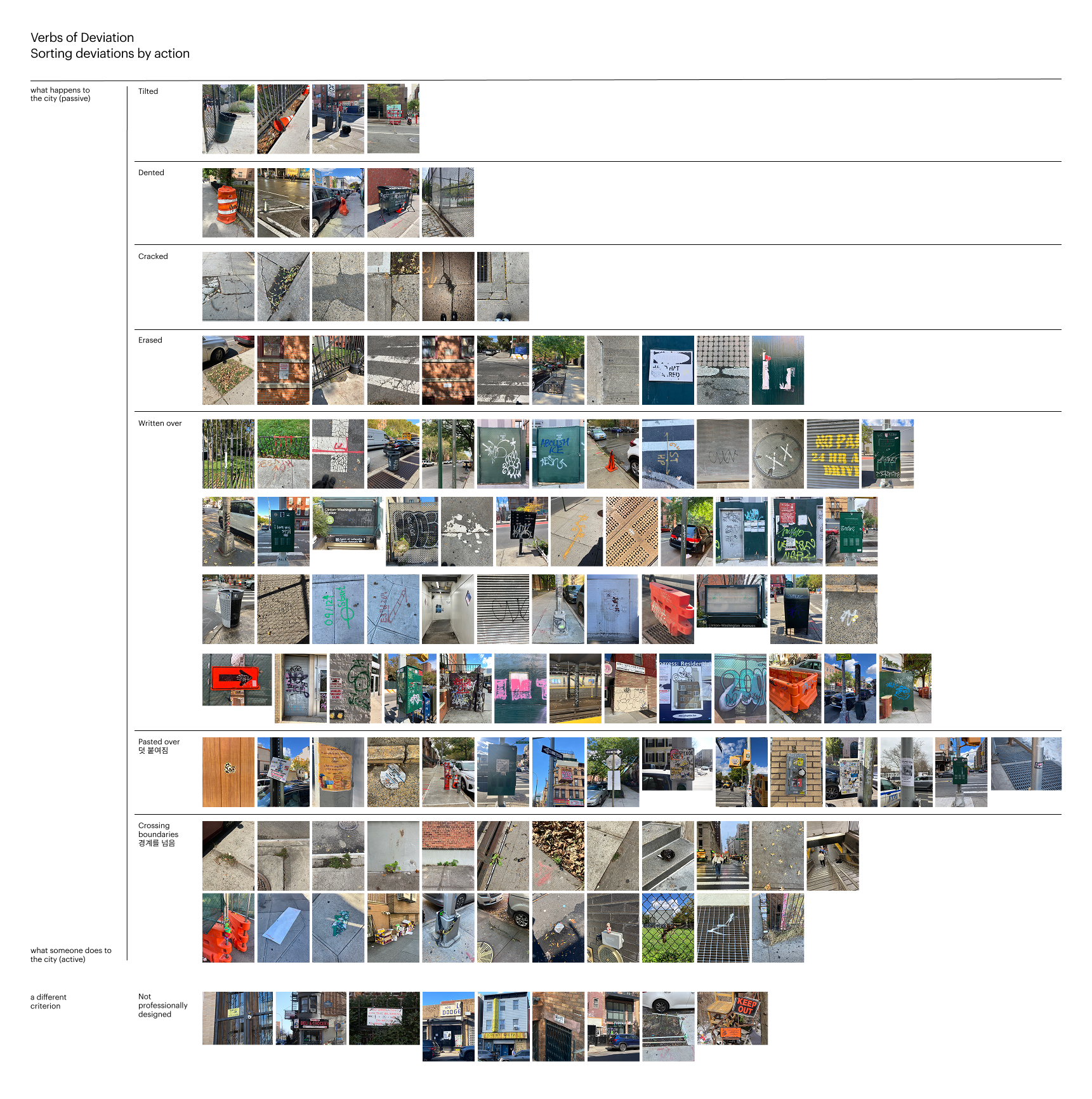
I photographed deviations in the city, the elements that do not quite fit, and sorted them. Here, a deviation means something that departs from the standards the city was designed around. This map sorts them by the verb through which each deviation happens: tilted, dented, cracked, erased, written over, pasted over, and crossing boundaries.

Credits & References

None

Week 3

Project file 1
Project file 2
Project file 3
Project file 4

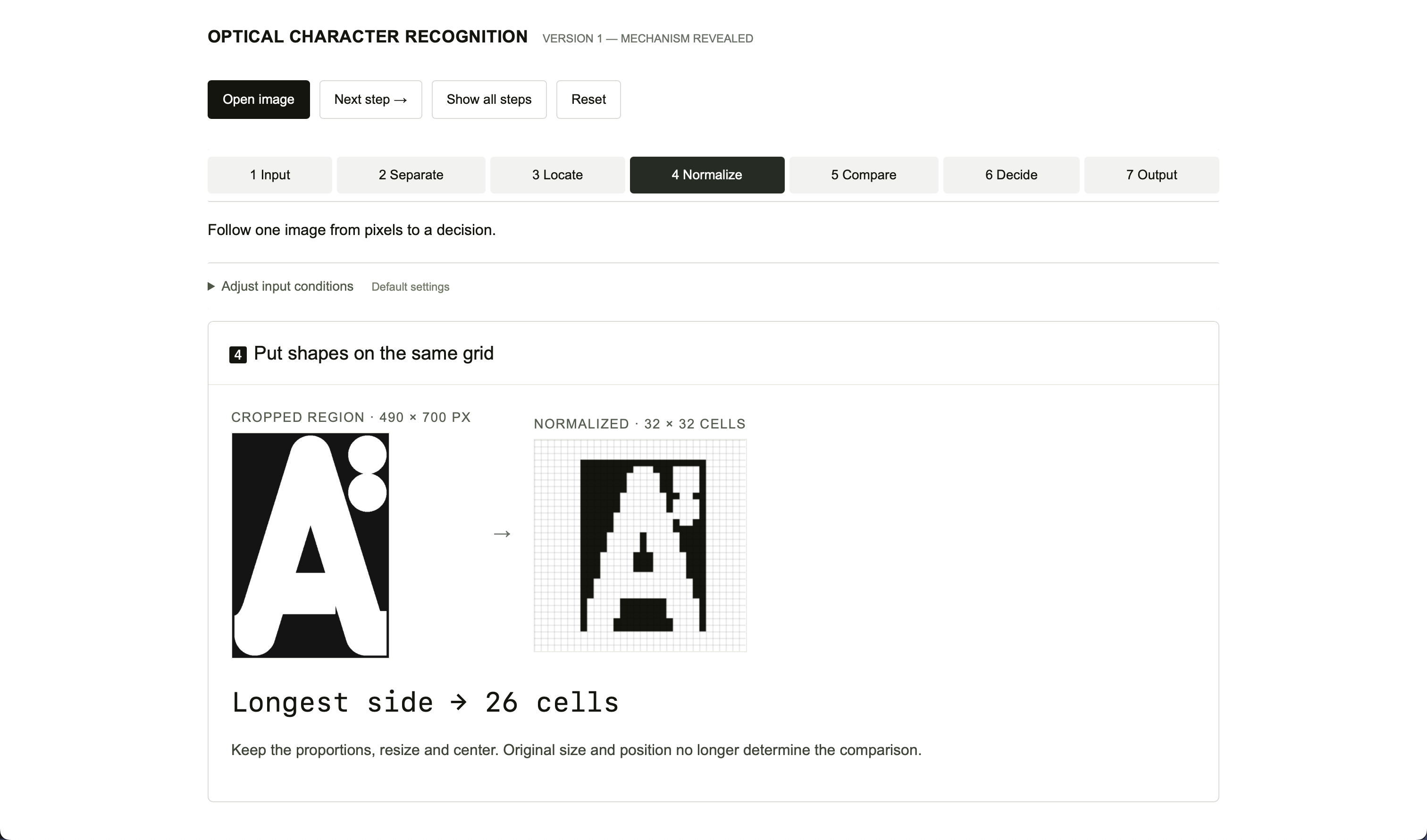
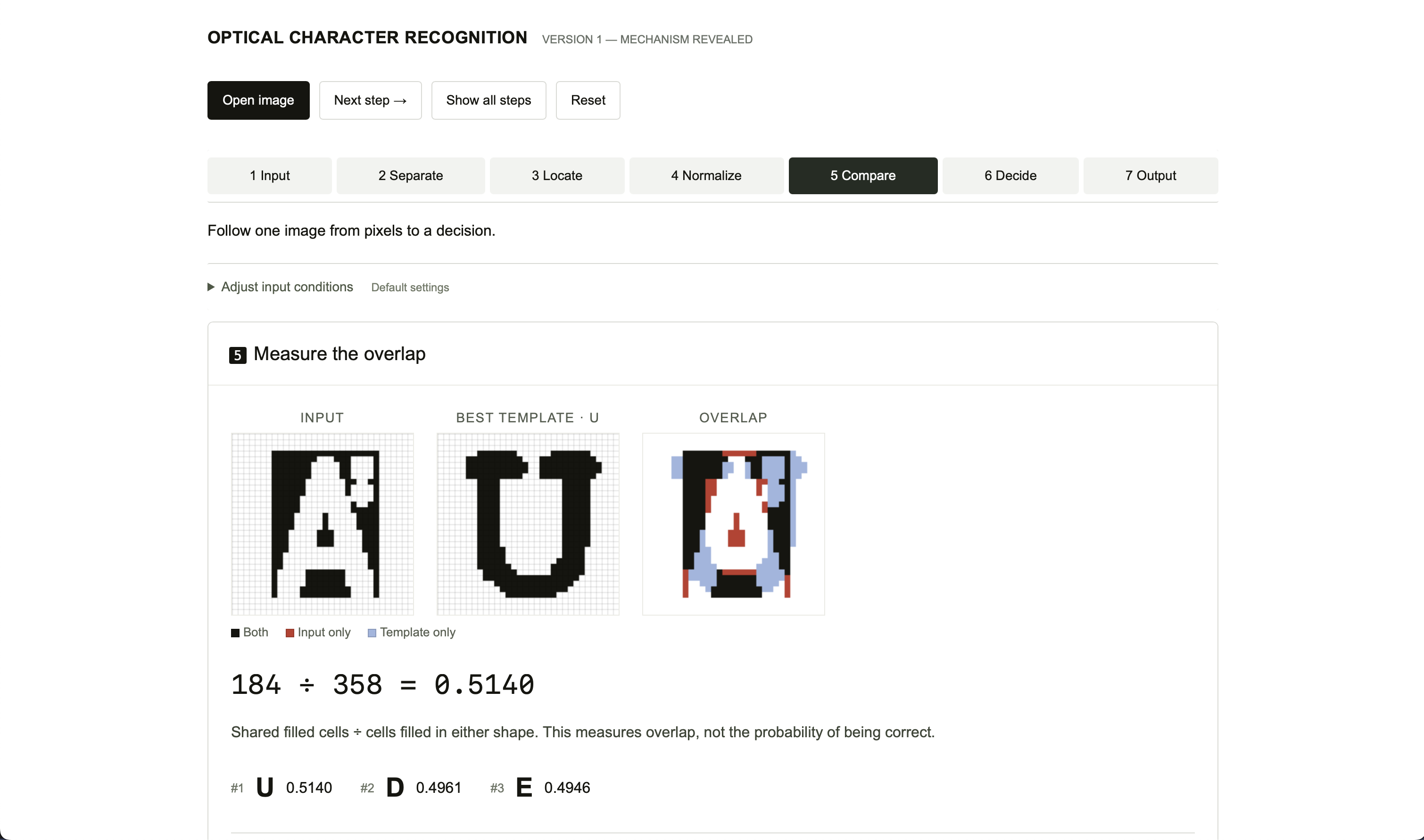
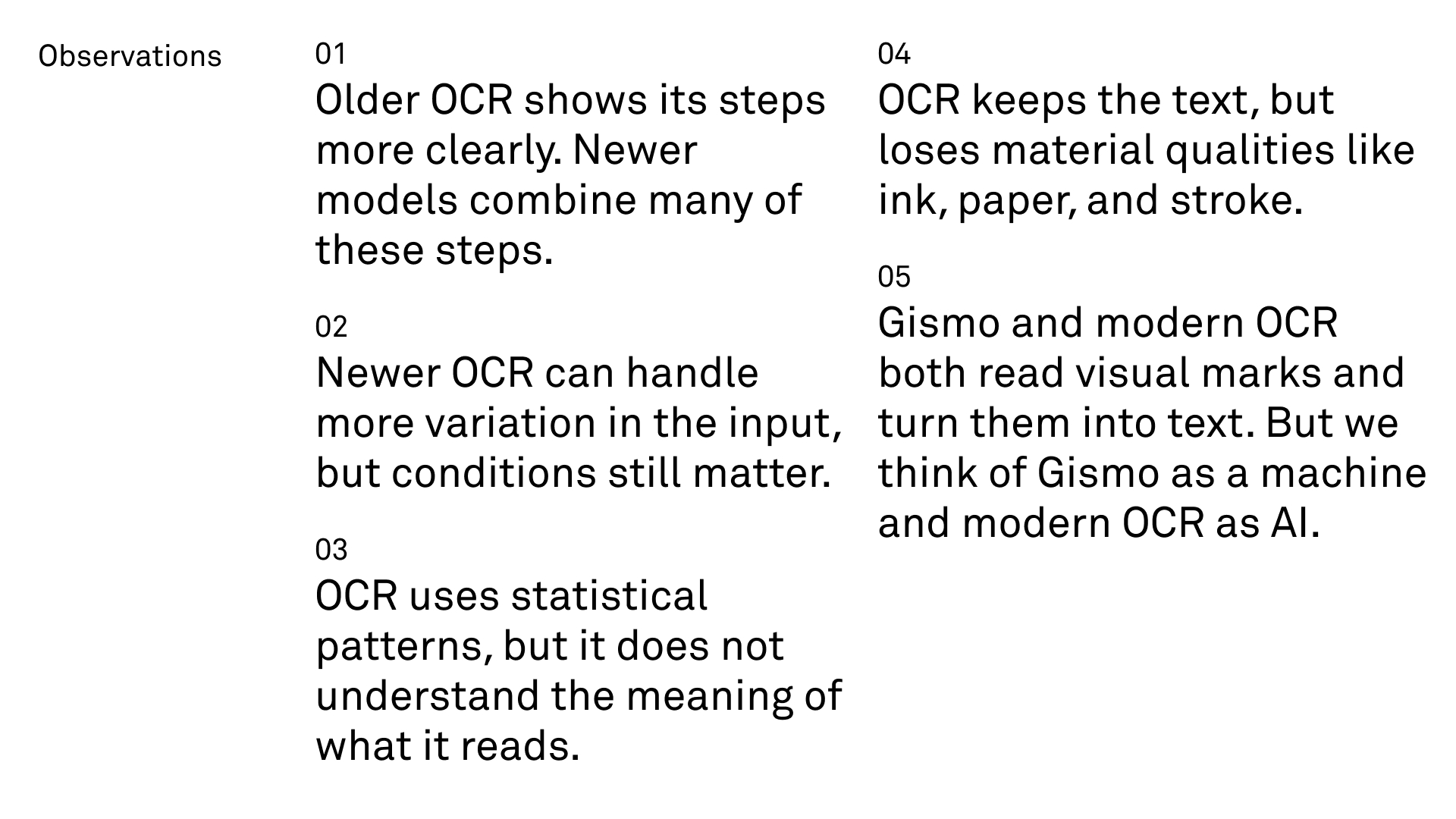
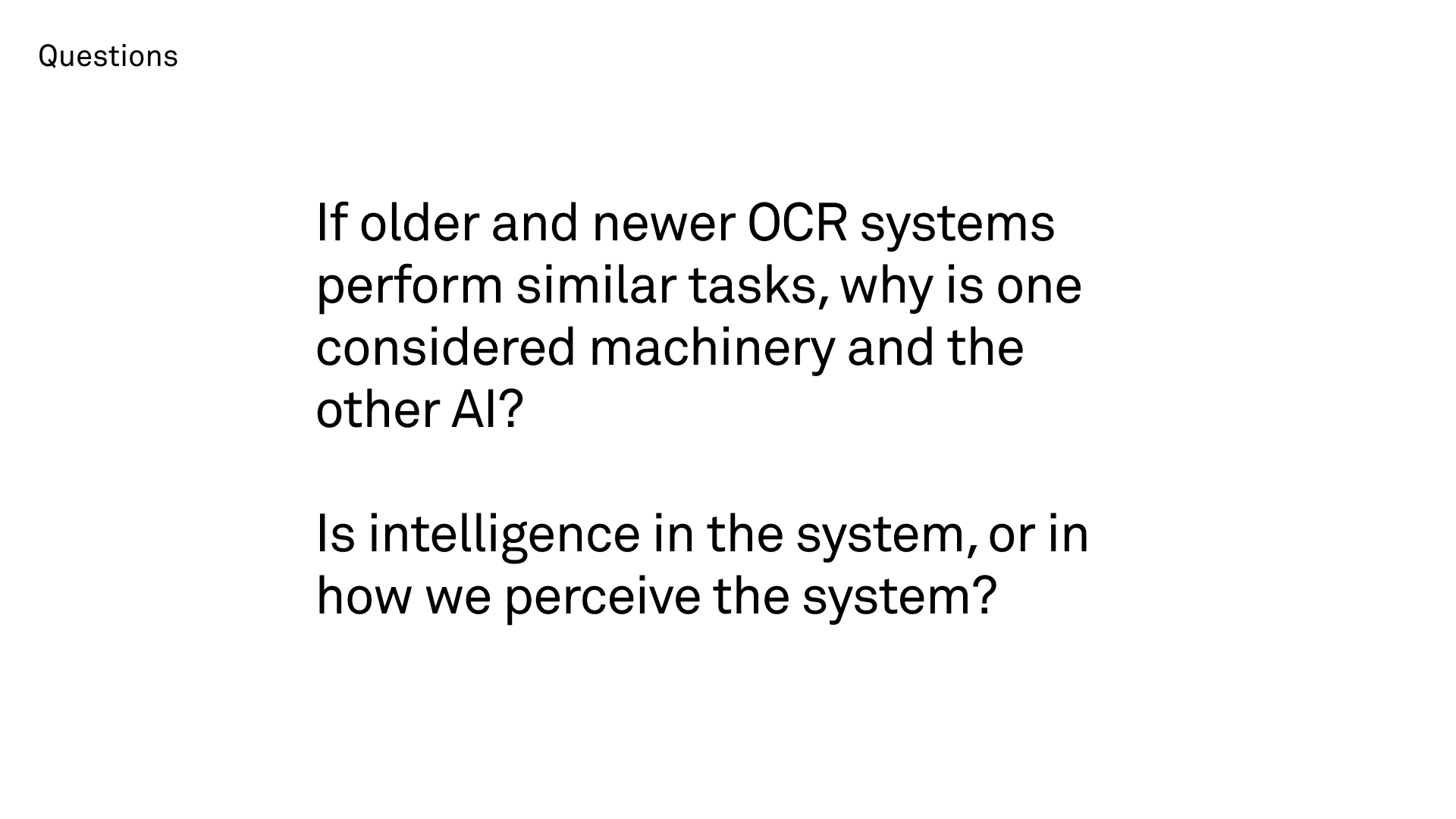
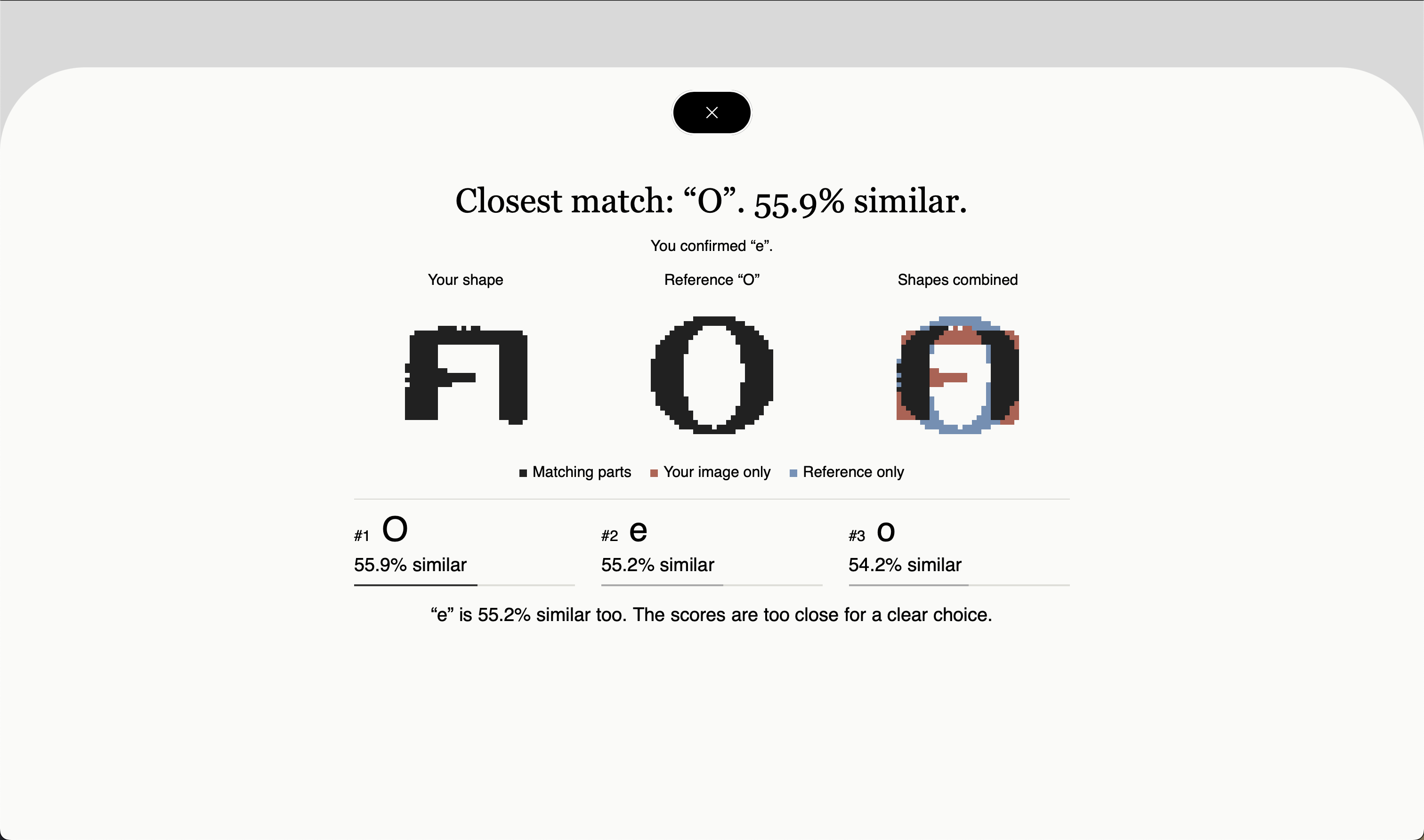
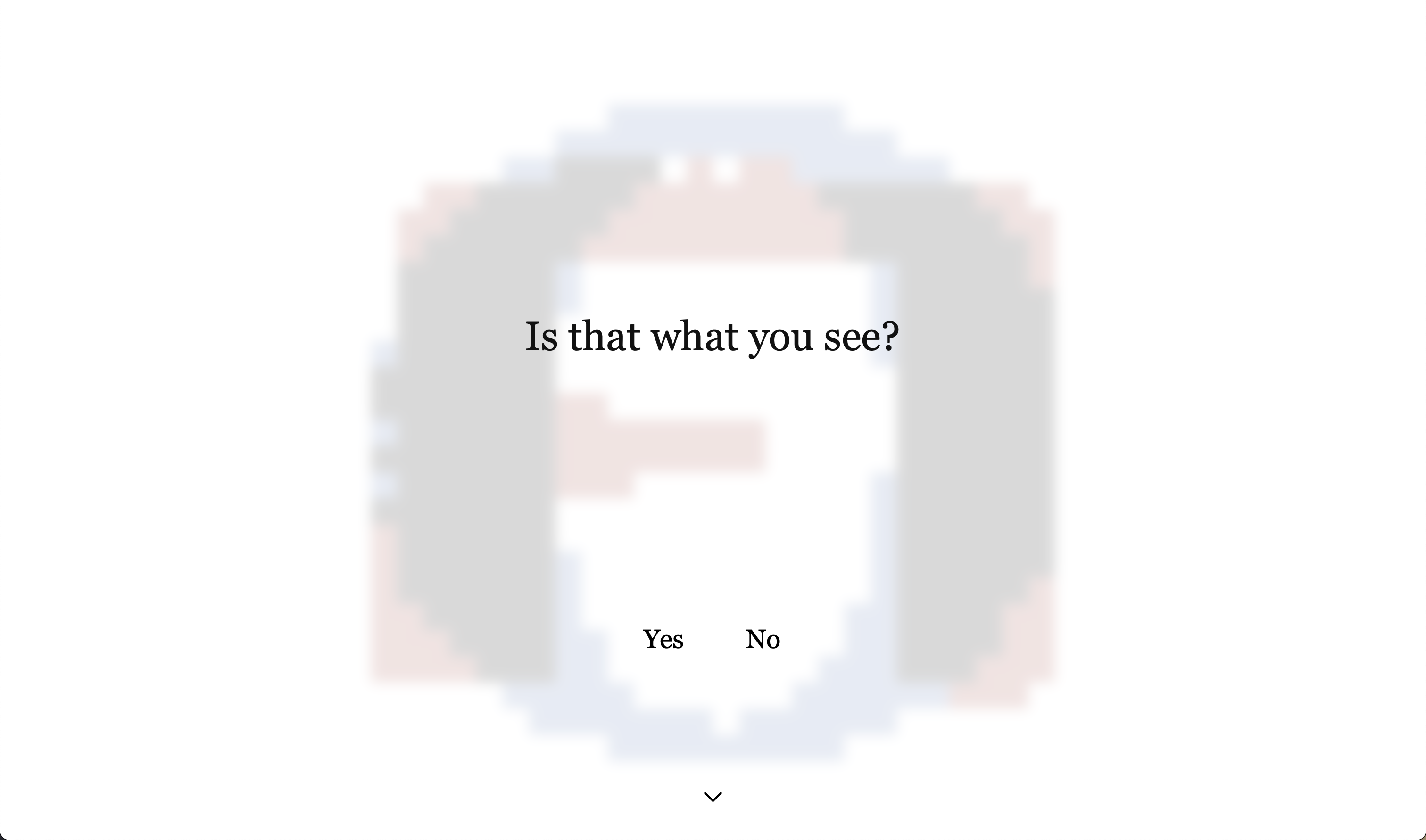
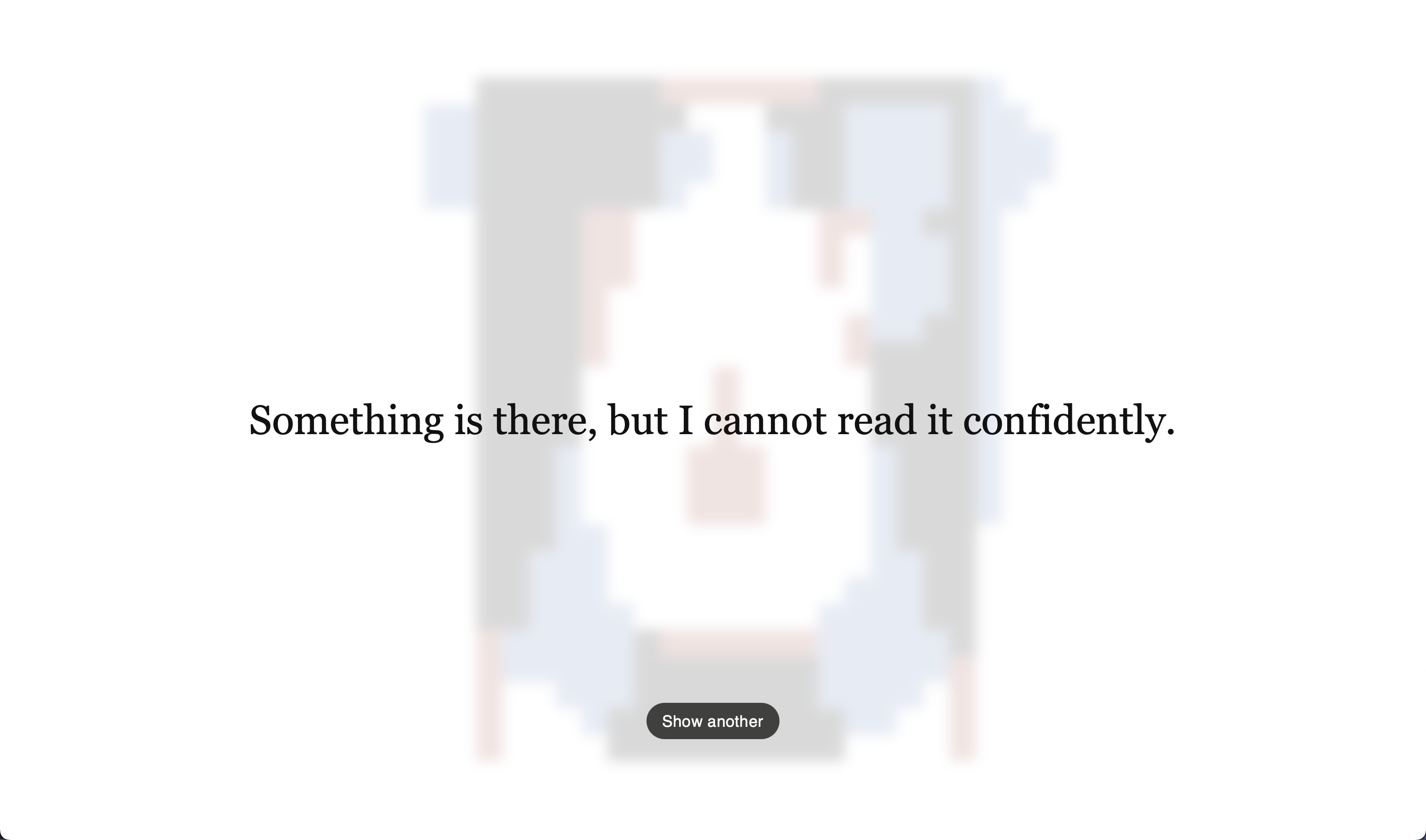
I made two versions of the same simple OCR system. Both compare an uploaded character with stored letter patterns. The first version reveals the image transformations, comparison scores, and decision rules. The second presents the result through a voice that describes visual features before reaching a conclusion, as if it is thinking aloud. In the background, the actual processing images gradually change—from black and white to pixels and pattern comparisons—but remain blurred. You can sense that something is happening without clearly seeing the rules. The spoken observations do not drive the decision; they present a calculation that has already happened.

Credits & References

Chat GPT

Week 1

Project file 1
Project file 2
Project file 3
Live Demo

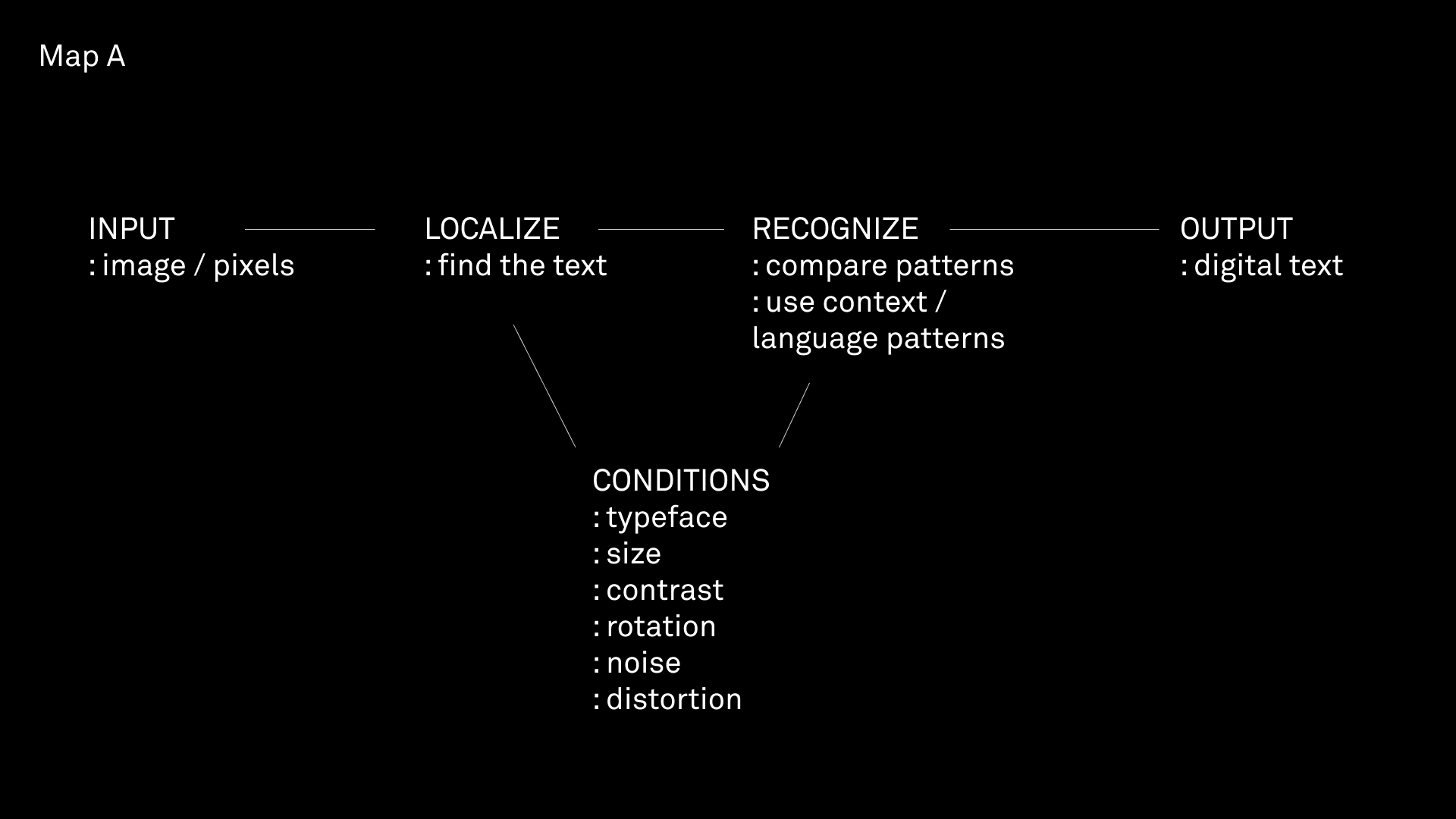
Understanding of OCR systems

Credits & References

Source Type, Adversarial Alphabets Part 1: How Machines Read David H. Shepard, Gismo and early OCR research Meta AI, Rosetta: Large Scale System for Text Detection and Recognition in Images Tesseract OCR Documentation

Week 4

Project file 1
Project file 2
Project file 3
Live Demo

Instead of simply presenting a result, the machine describes what it sees, expresses uncertainty, and asks users whether its answer is correct. Users can also explore another possible answer and see the similarity scores behind its decisions. The system’s calculations remain the same, but its language and interaction change how we experience them.

Credits & References

Chat GPT

Week 2

Project file 1
Project file 2
Project file 3
Project file 4
Project file 5
Live Demo

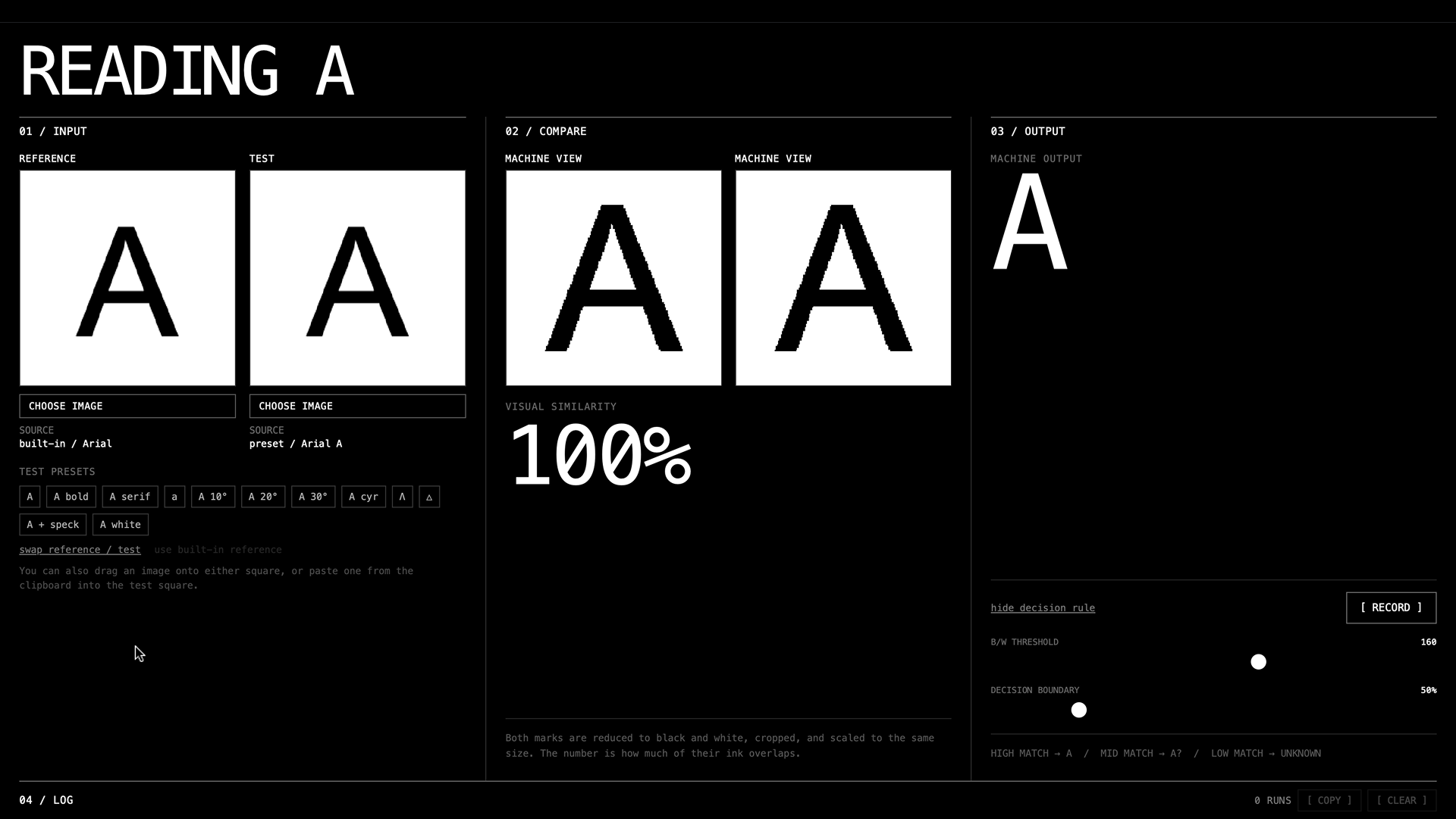
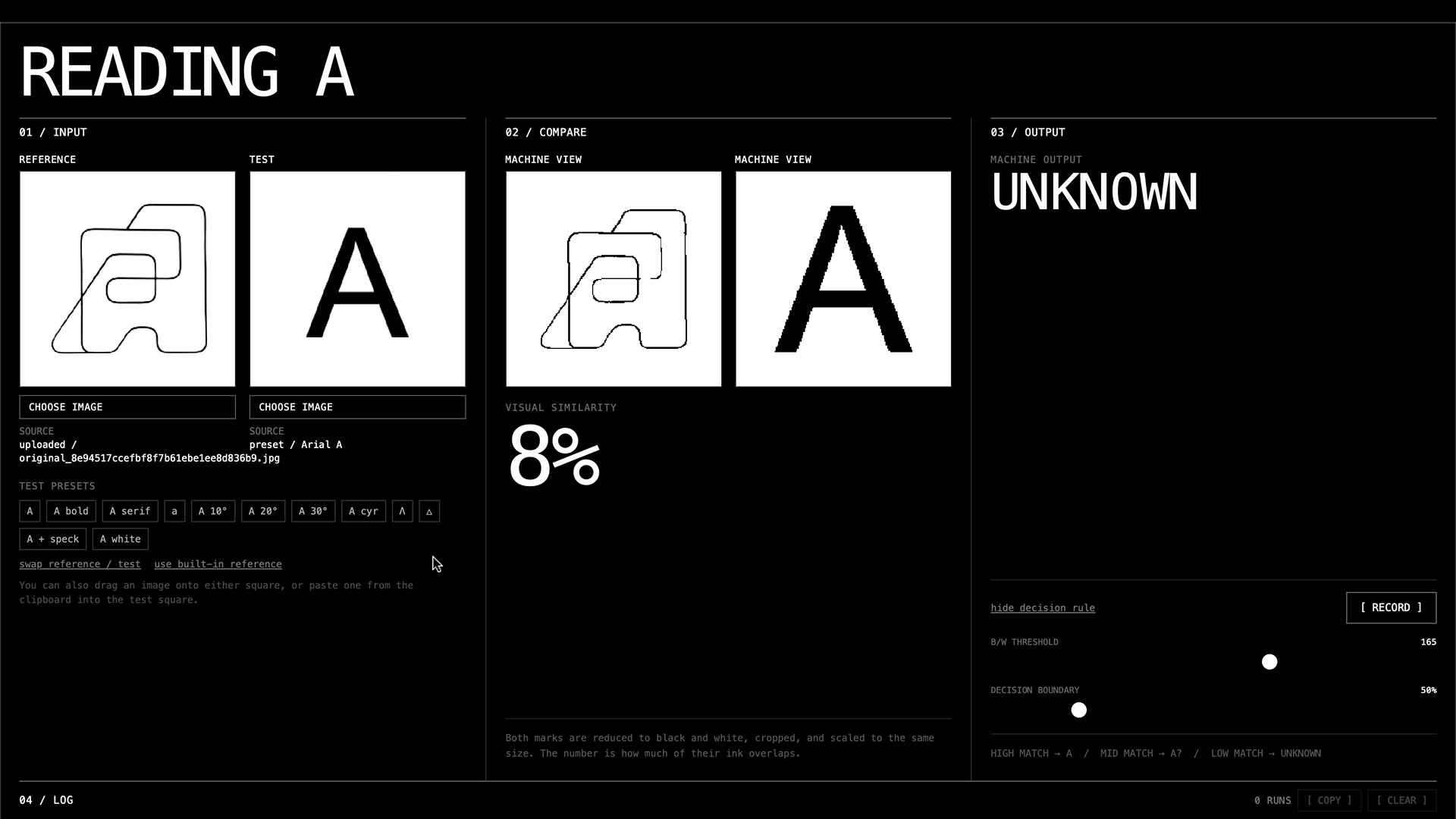
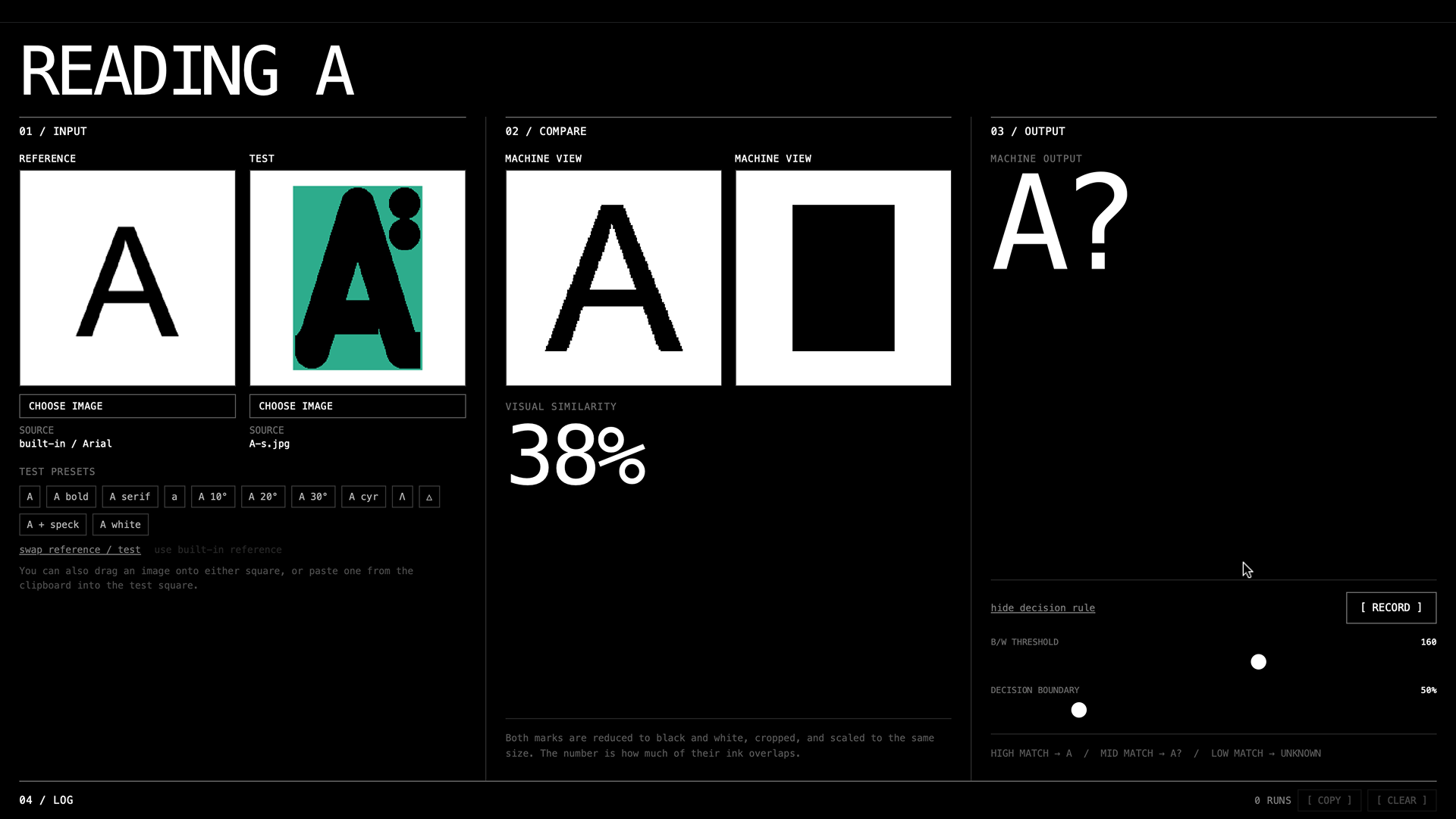
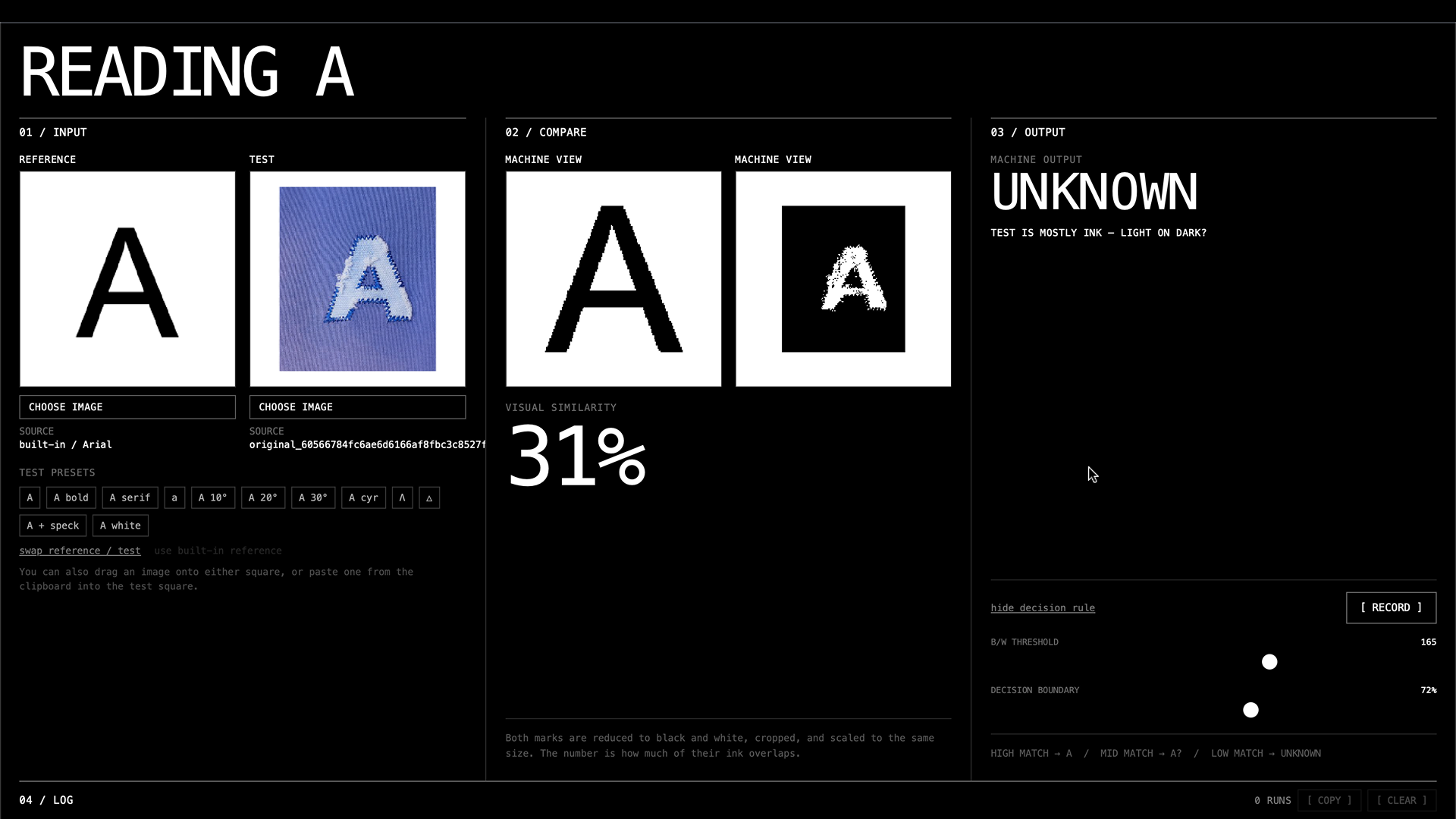
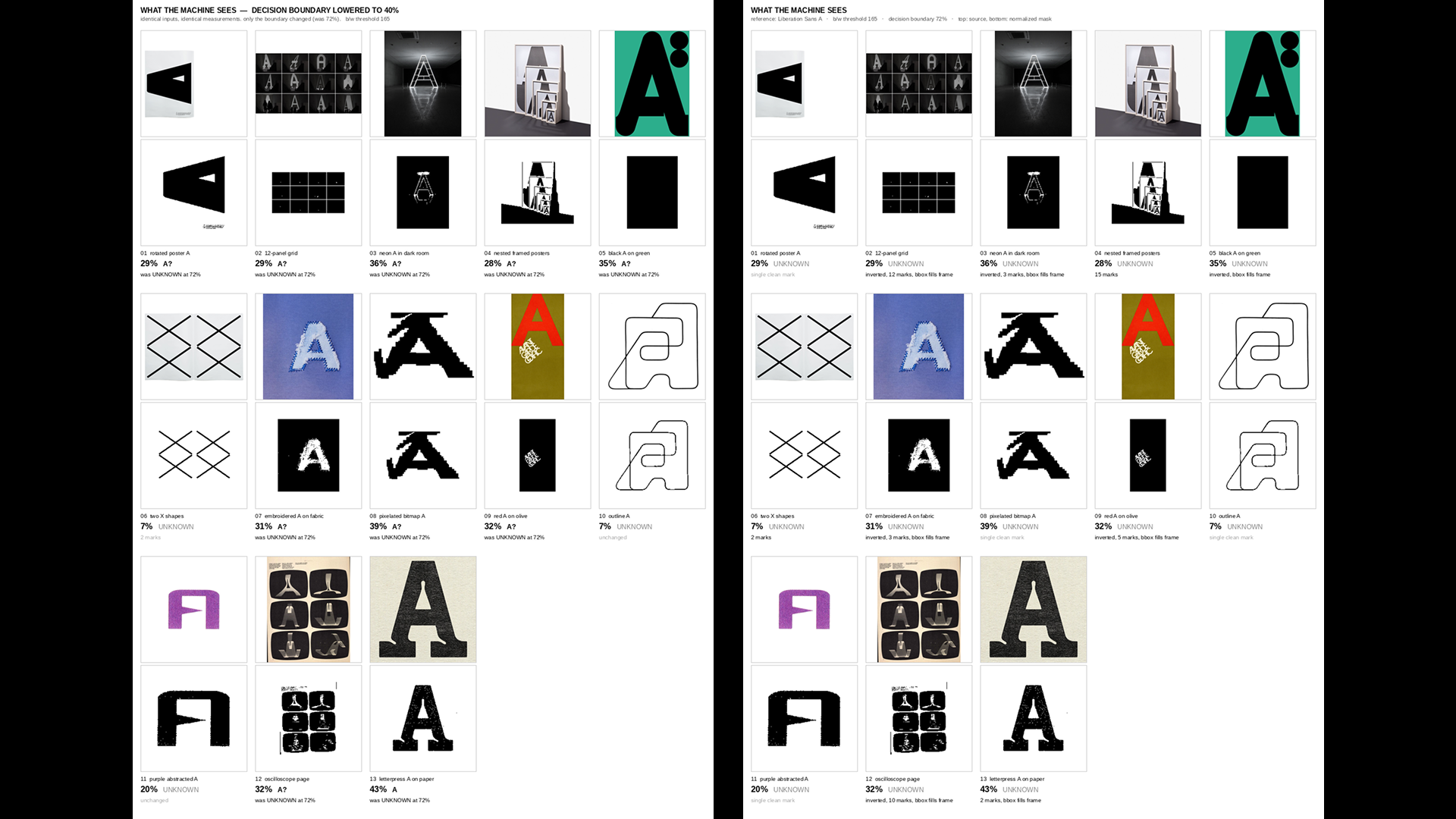
Reading A is a small reconstruction of one part of OCR: visual comparison and classification. The prototype begins with a single reference image, an Arial “A.” Every test image is converted into black and white, cropped, scaled to the same size, and compared with this reference. The system calculates how much the two shapes overlap and produces a similarity score. Based on a decision boundary that I set, the result is labeled A, A?, or UNKNOWN. I tested the system with different typefaces, handwritten and photographed letters, rotated forms, similar characters, geometric shapes, and different color conditions. Through these tests, I found that the system does not have a general concept of what the letter A is. It only knows the specific A that I selected as its reference. The experiment also showed how much information disappears when an image is simplified for machine comparison. Colors, materials, and other visual qualities can be lost during binarization before the comparison even begins. Most importantly, I found that the final answer depends not only on the input or the similarity score, but also on the threshold I choose. Changing the threshold can change the output without changing the image or the measurement.
Credits & References

Claude