Week 6

Project file 1
Live Demo

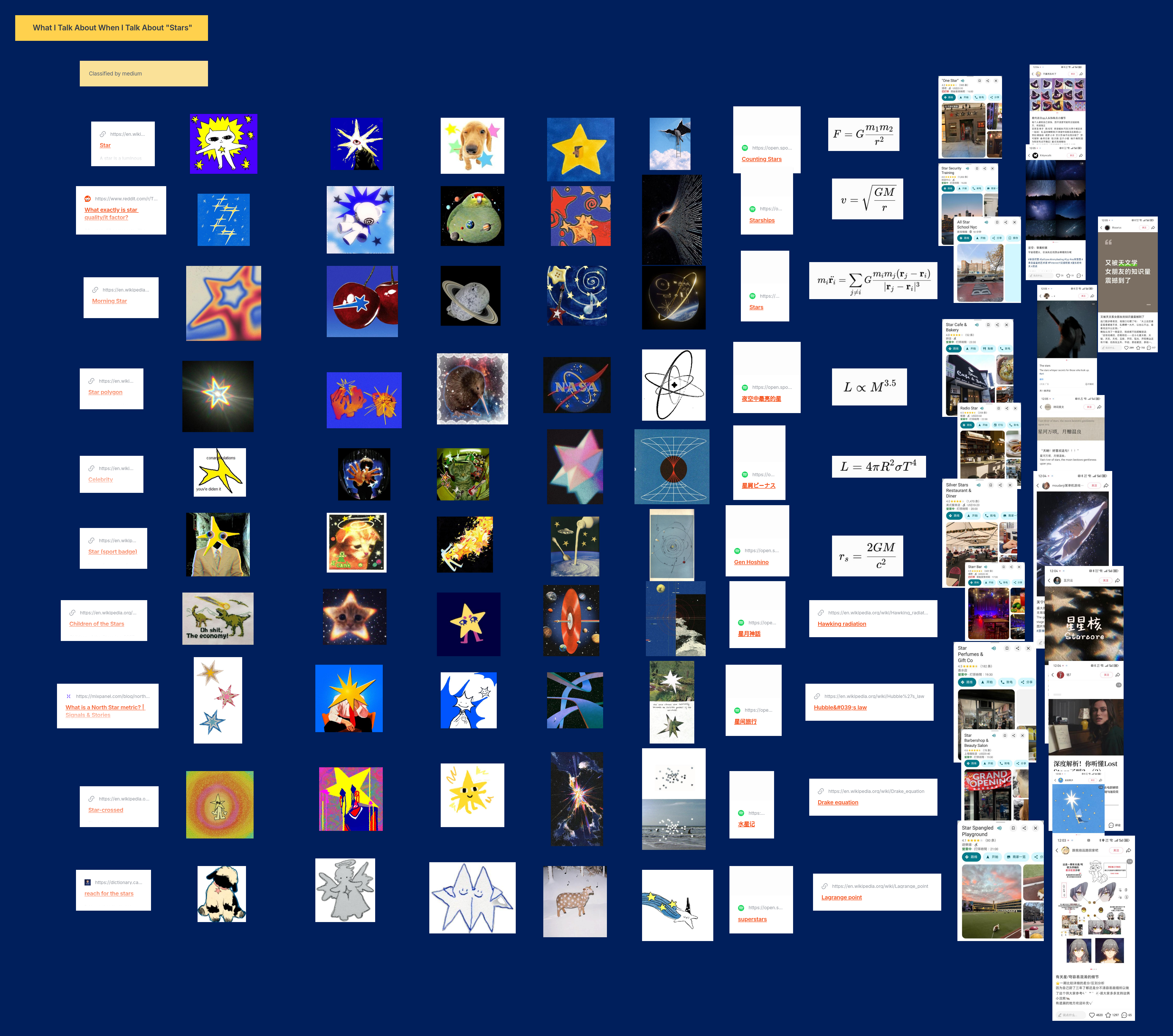
What I Talk About When I Talk About "Stars" For this project, I chose "Star" as my collecting theme. The multifaceted nature of the word "Star" promised a rich collecting process, so I searched for the term across various platforms and gathered a wide range of related content—spanning actual stars, star shapes, anthropomorphic stars, game characters, celebrities, songs, and more. For the time being, I have categorized these items based on their medium.

Credits & References

Google, Pinterest, Wikipedia, Rednote, Spotify

Week 3

Project file 1
Project file 2
Project file 3
Project file 4
Live Demo

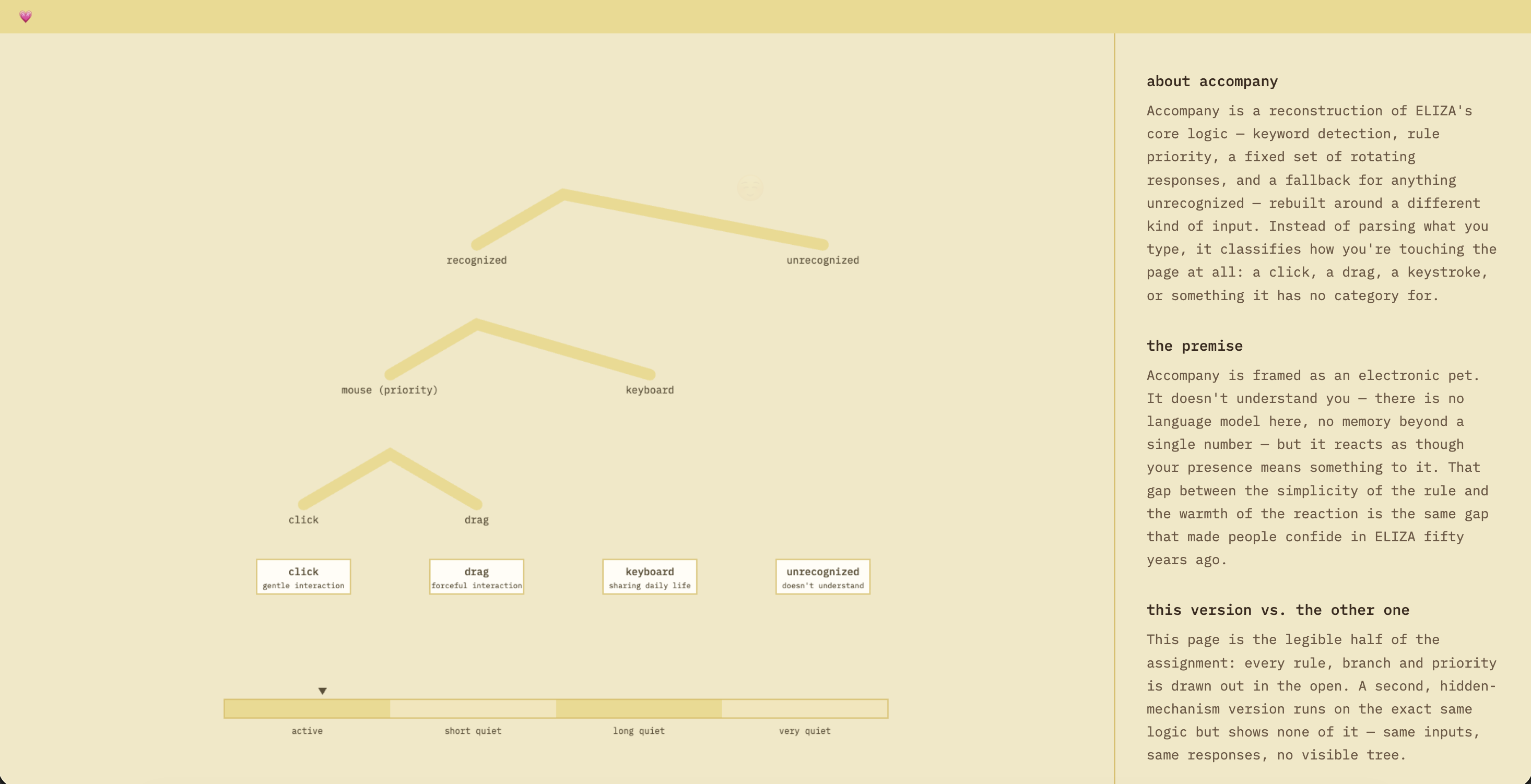
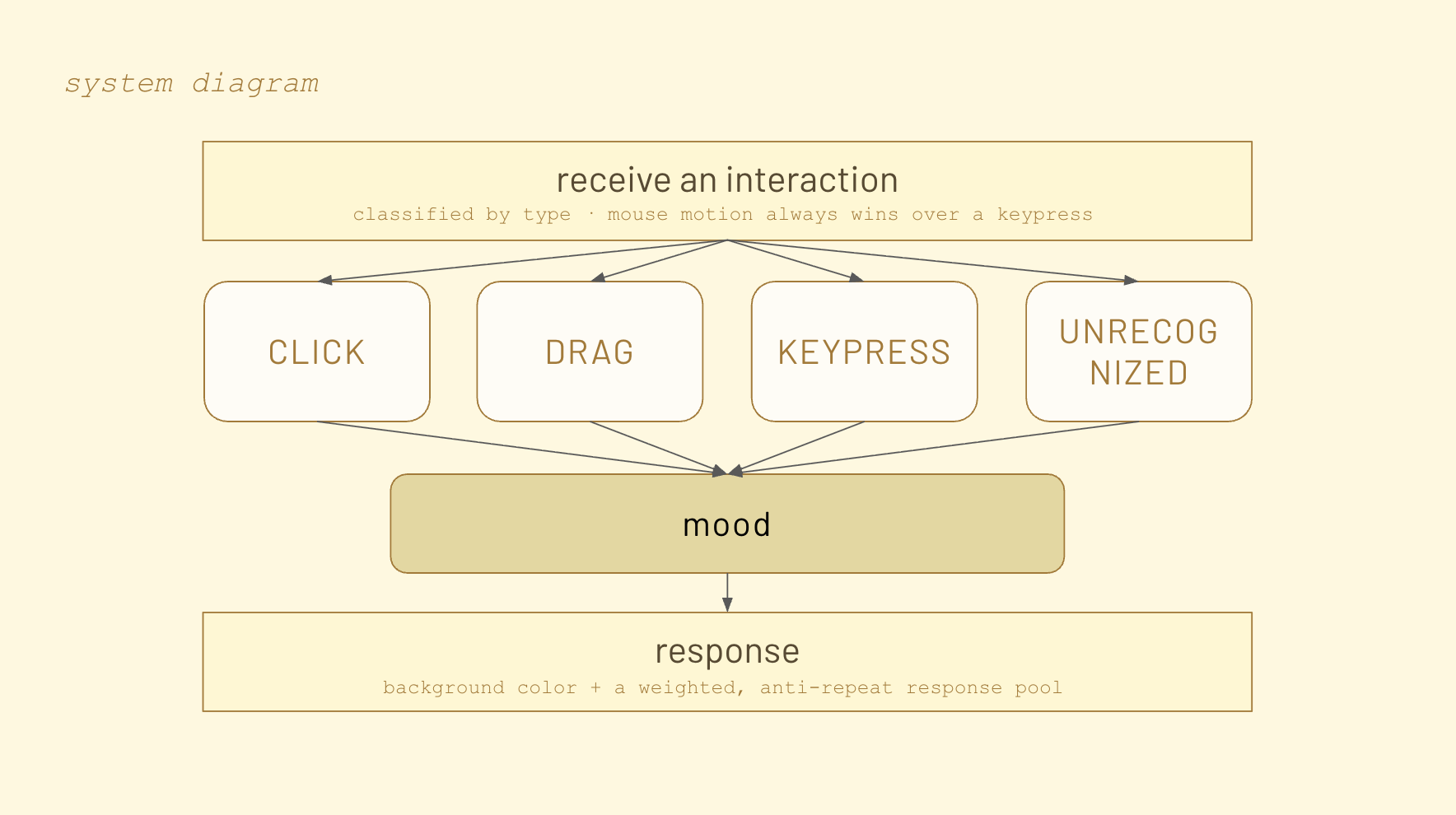
Accompany reconstructs ELIZA's core logic — keyword detection, priority, and rotating responses — around a different kind of input: not what someone types, but how they touch the page at all (a click, a drag, a keystroke, or something unrecognized). A single decaying value stands in for "mood," and a separate timer narrates the system's own idle silence. The project pairs two interfaces built on that one mechanism. A legible version draws every rule and branch out in the open, so any response can be traced back to its exact cause. A hidden-mechanism version, framed as a small electronic pet, runs the identical logic behind a quiet title and an accumulating log, showing none of it. The comparison is the point: what changes when the same simple ruleset is dressed up to seem attentive, needy, or alive.

Credits & References

Claude, ChatGPT, ELIZA

Week 1

Project file 1
Live Demo

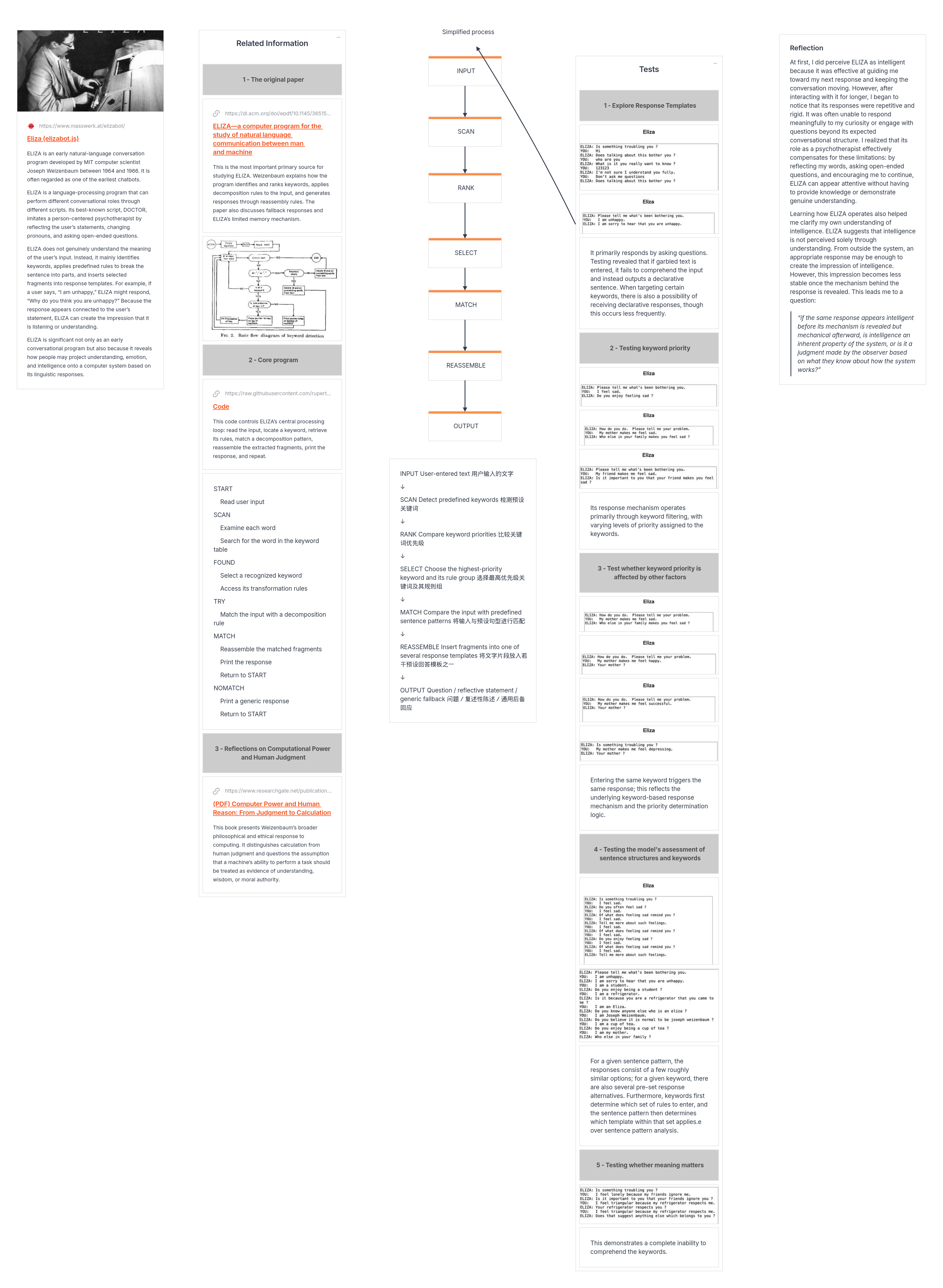
For this week, I chose Eliza as the subject of my research. I investigated its usage, response logic, and history, and tried using the chatbot myself. This deepened my understanding of what constitutes "intelligence" and gave me insight into the operating principles of chatbots prior to the era of LLMs.

Credits & References

Used ChatGPT for information research and code reading. Joseph Weizenbaum. 1966. ELIZA—a computer program for the study of natural language communication between man and machine. Commun. ACM 9, 1 (Jan. 1966), 36–45. https://doi.org/10.1145/365153.365168 Computer Power and Human Reason: From Judgment to Calculation DOI:10.2307/3103715

Week 4

Project file 2
Project file 3
Project file 4
Live Demo

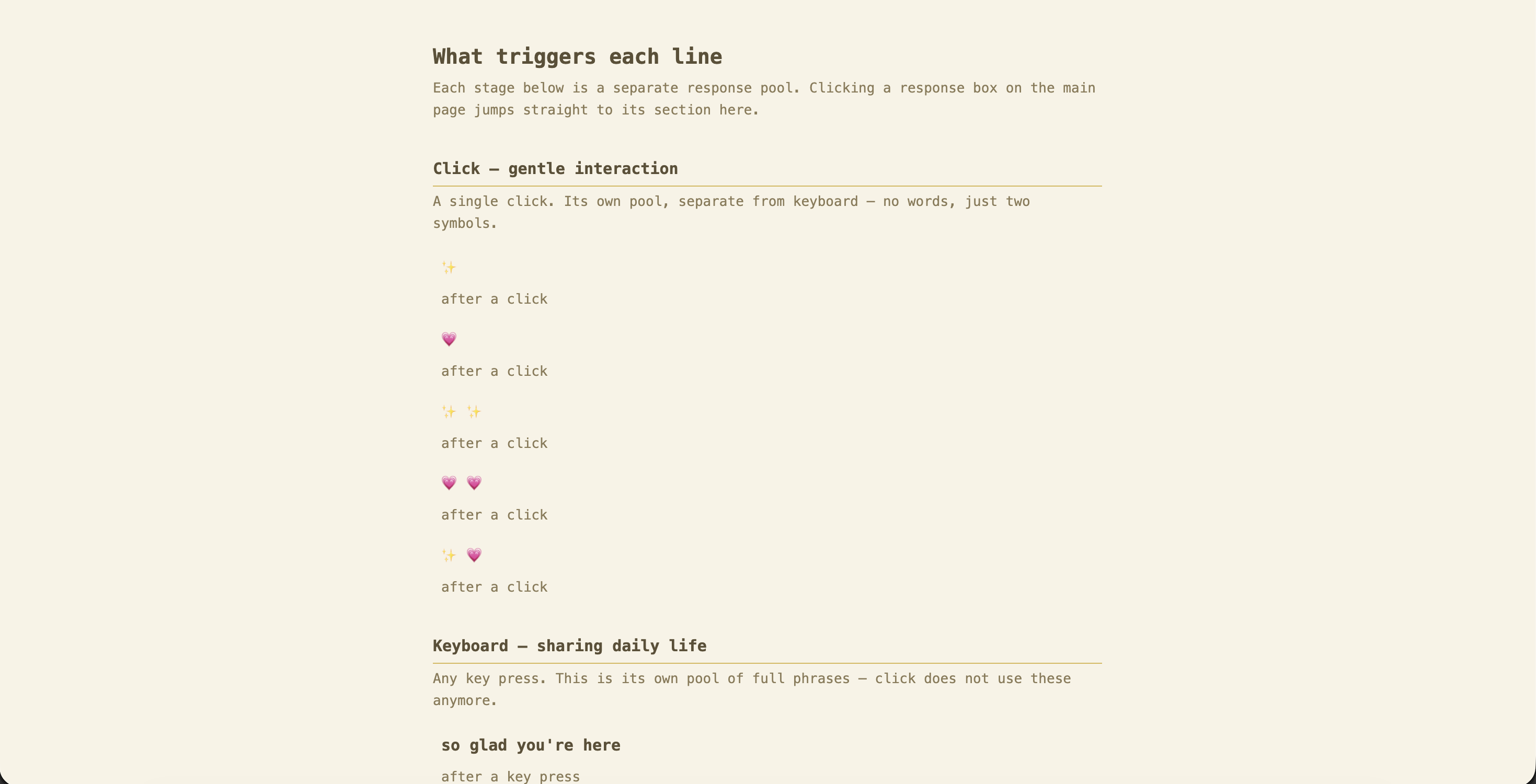
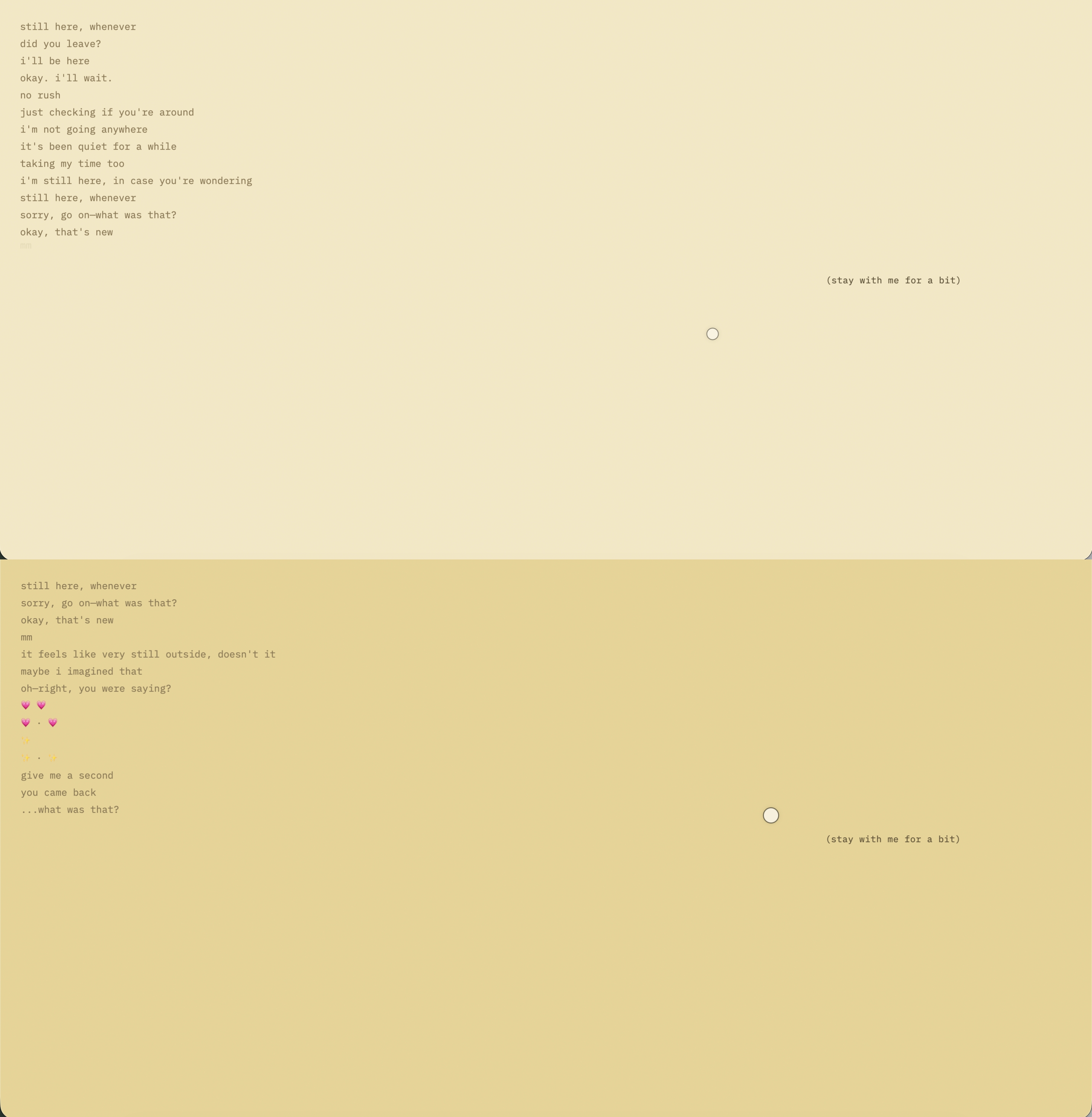
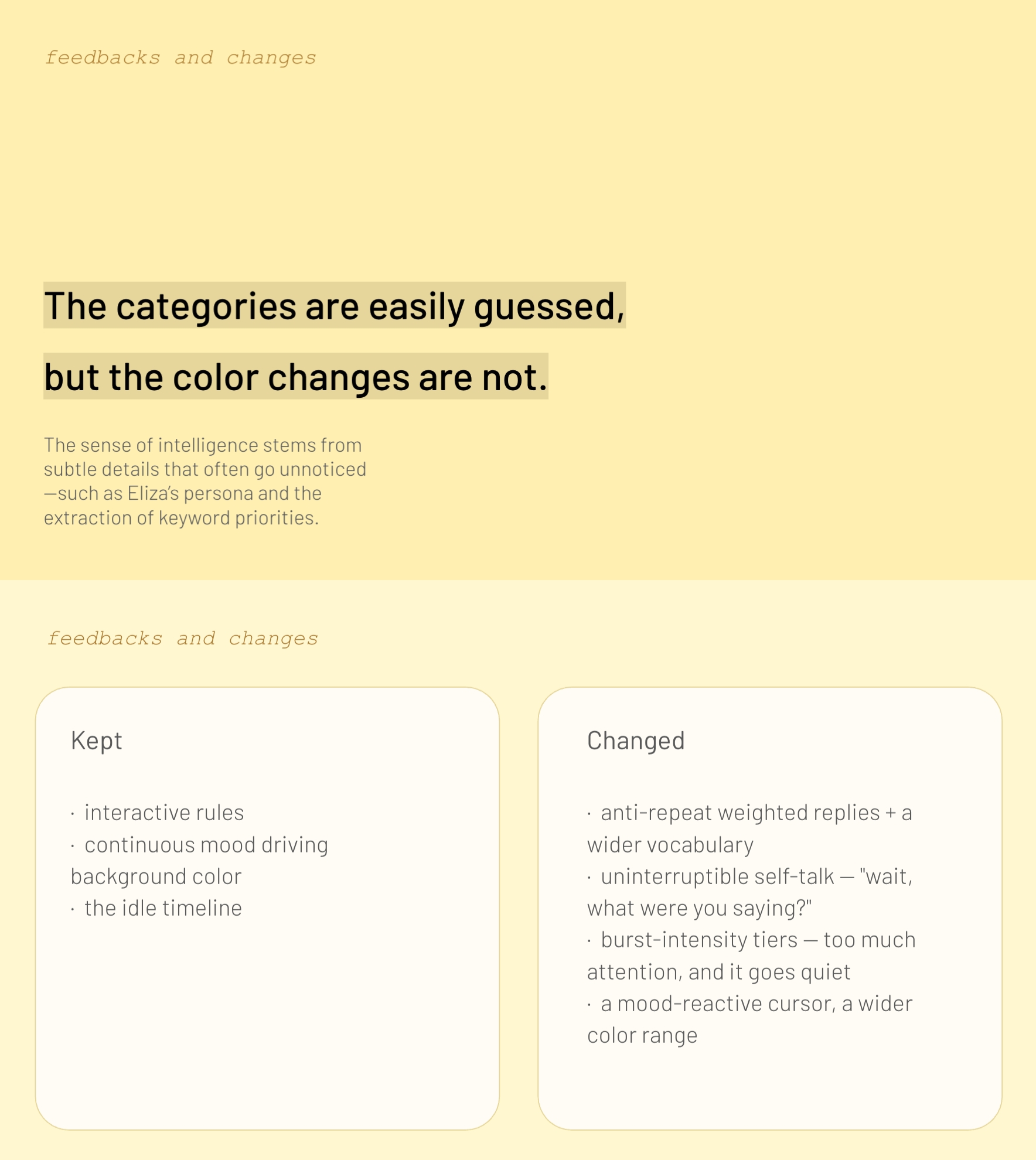
Accompany is a rule-based interactive companion built on ELIZA-style logic: it classifies user input (click, drag, keypress, or unrecognized input) and responds through fixed pools of pre-written reactions, with no language understanding anywhere in the system. The project explores whether the feeling of being understood can exist without any actual understanding behind it. Two earlier versions tested this split: one exposed its decision logic openly, the other hid it behind the same rules. Feedback showed participants could reverse-engineer the discrete input categories, but not the one continuous, cumulative mechanism — a mood value that drives the background color and decays over time. The final prototype builds on that finding, keeping the mood system as its core and adding behavioral cues on top of the same rule set: memory (self-talk that resumes an interrupted thought), hesitation (a burst-tiered response that goes silent under sustained attention), and controlled unpredictability (anti-repeat weighted replies) — aiming to feel alive through timing and persistence rather than through comprehension.

Credits & References

Claude

Week 2

Project file 1
Project file 2
Live Demo

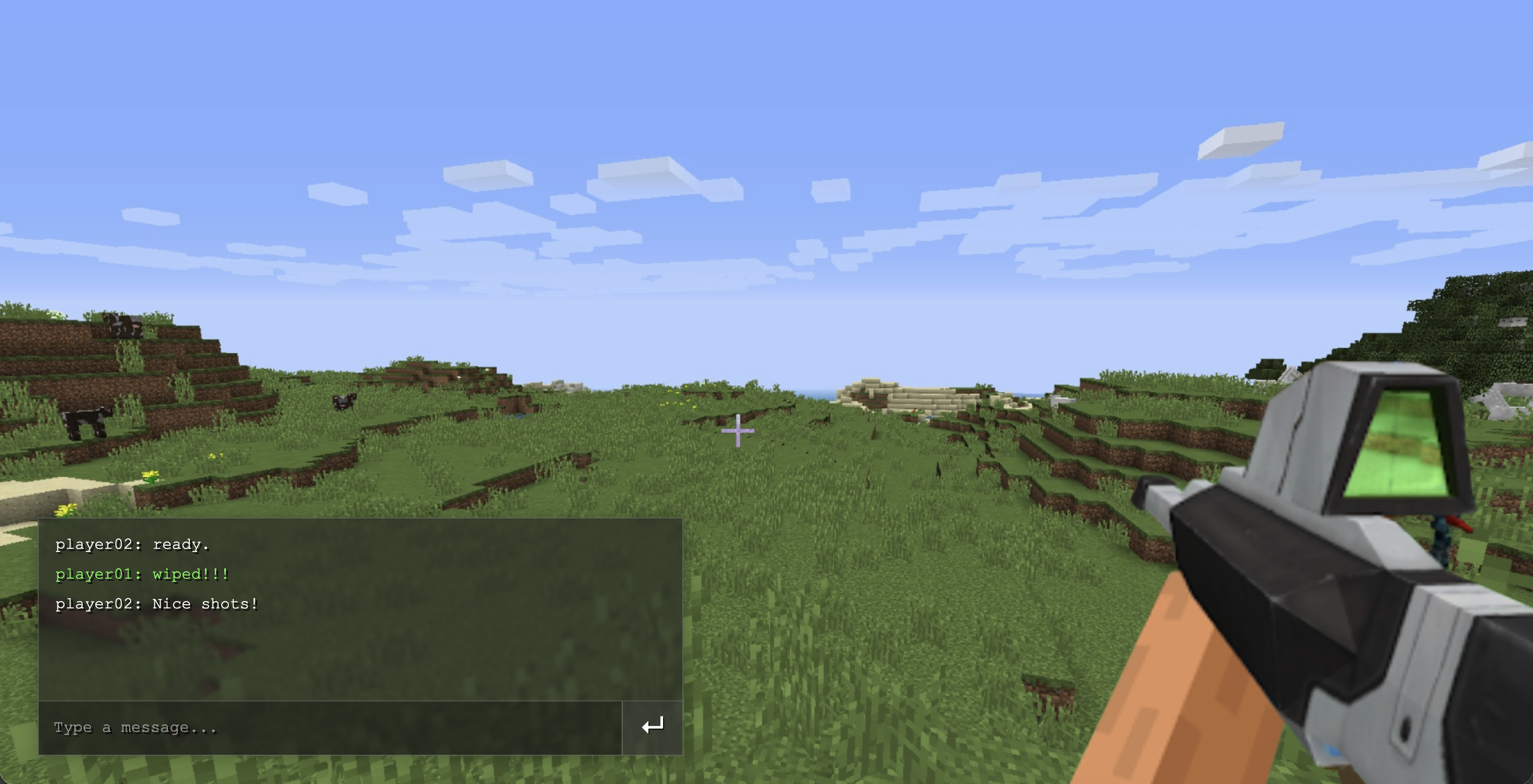
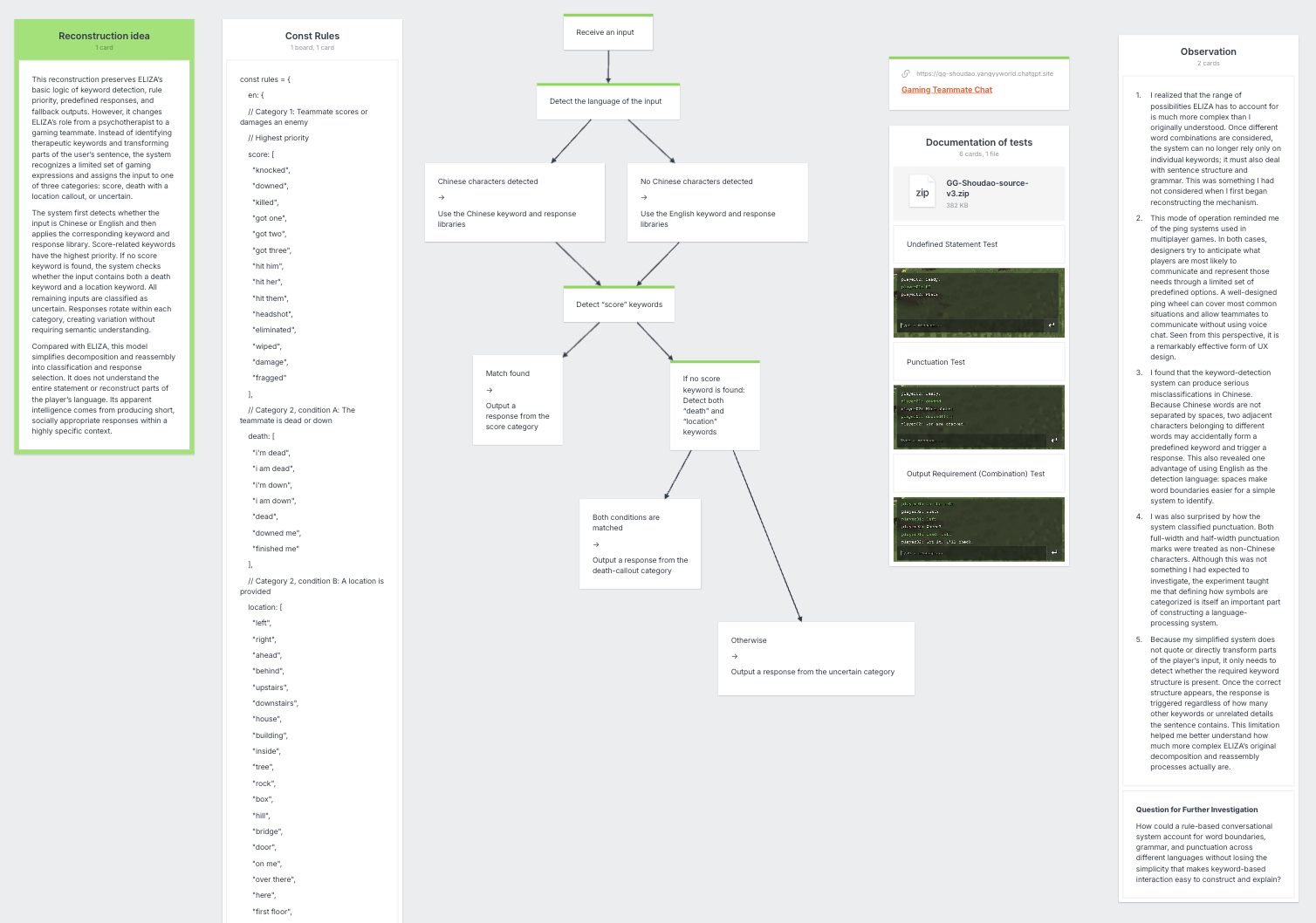
This reconstruction preserves ELIZA’s basic logic of keyword detection, rule priority, predefined responses, and fallback outputs. However, it changes ELIZA’s role from a psychotherapist to a gaming teammate. Instead of identifying therapeutic keywords and transforming parts of the user’s sentence, the system recognizes a limited set of gaming expressions and assigns the input to one of three categories: score, death with a location callout, or uncertain. The system first detects whether the input is Chinese or English and then applies the corresponding keyword and response library. Score-related keywords have the highest priority. If no score keyword is found, the system checks whether the input contains both a death keyword and a location keyword. All remaining inputs are classified as uncertain. Responses rotate within each category, creating variation without requiring semantic understanding. Compared with ELIZA, this model simplifies decomposition and reassembly into classification and response selection. It does not understand the entire statement or reconstruct parts of the player’s language. Its apparent intelligence comes from producing short, socially appropriate responses within a highly specific context.

Credits & References

Eliza Chat GPT